Current work — live
I bought a dead domain
and brought 7,000
wineries back to life.
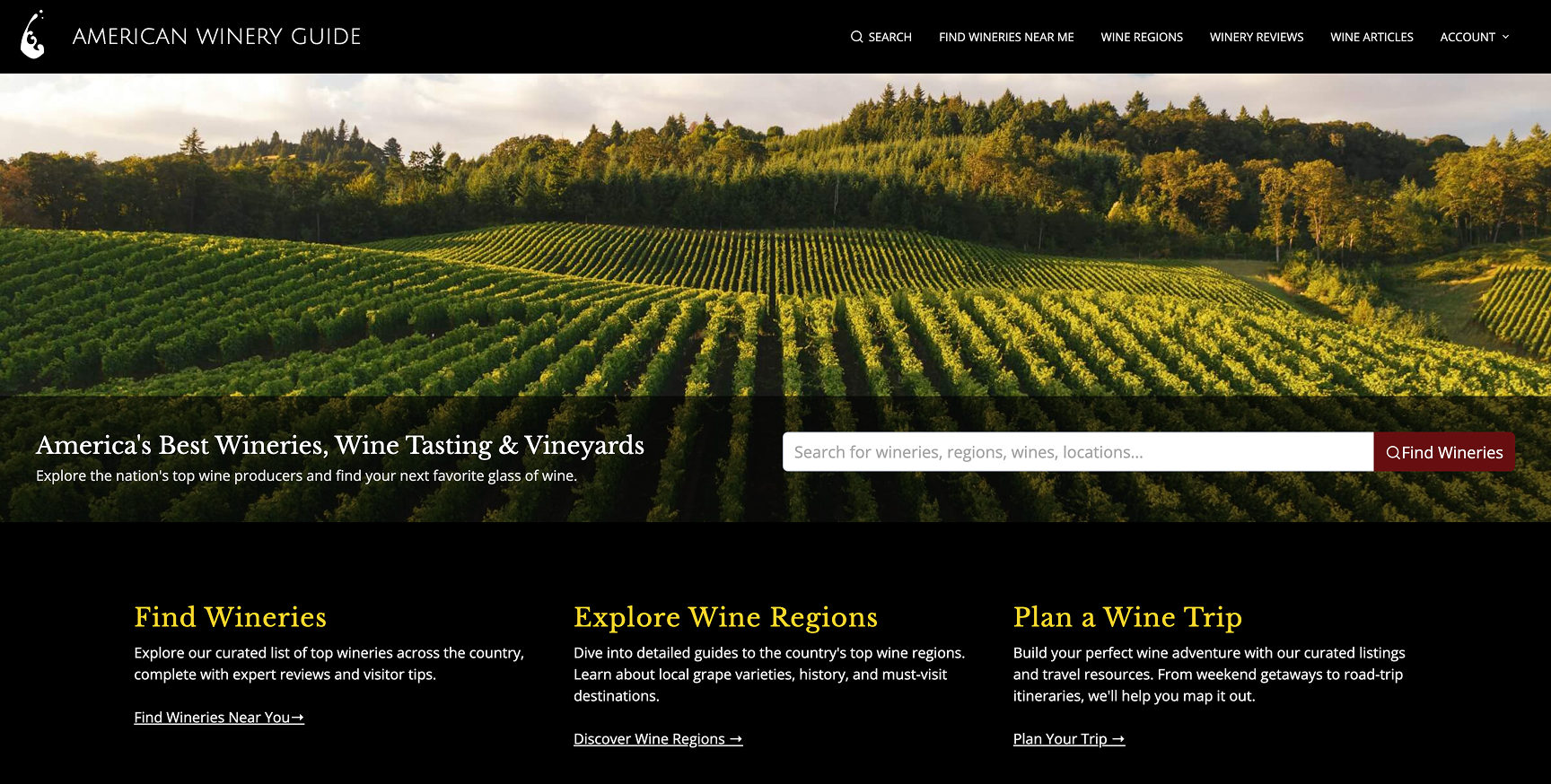
AmericanWineryGuide.com is the directory I wished existed every time I planned a wine trip. It now has roughly 7,000 wineries, 800 in-depth reviews, and around 50,000 unique visits a month. Rebuilt from the ground up to thrive in the AI age.
The conviction
My wife and I plan our vacations around wineries. We've done it on three continents. And every time, the internet lets us down the same way: it treats wine as a thing to score. Ninety-point ratings, shelf-talker notes. But the part we go for is the visit. Who's making the wine, the story they tell across the bar, whether the place is worth the drive.
So the guide is built for the trip rather than the cellar. It's for the person typing "wineries near Charlottesville" into their phone working out where to spend a beautiful Saturday among the vines.
The restoration — what I inherited
I didn't start from nothing, which was the problem. In 2020 I bought the domain off an SEO flipper who'd stripped the original site for parts and left the shell standing. It still pulled real search traffic, just to a corpse. Under the hood it was worse than dead: circular redirects looping back on themselves, the same content duplicated across dozens of URLs, links pointing out to thai gambling sites. Out of 11,000 listings, close to 4,000 of them broken or fake, and whole regions, towns, and AVAs with nothing real in them at all.
That's the part of this most like the rest of my life. I can't look at something neglected and walk away from it. A gutted ~20-year-old domain is the same itch as a rusted hand plane or a dead game console: strip it down, find what's worth keeping, and bring it back.
The build
Then I rebuilt the whole thing from the ground up. I wrote a crawler that went out to every legitimate winery site, and a set of AI agents to read those sites and write fresh descriptions for each one, verifying what was real and filling two decades of gaps, winery by winery, region by region.
I'd never built any of it before I needed it. Python, Flask, Postgres, wrangling AI agents. I learned all of it on this project, because there was no one else to. The infrastructure nearly broke me. I'd spent years helping design observability tools, the kind teams use to watch their own systems and figure out why something's on fire, and it turns out you never really understand those tools until you're the one at 1 a.m. leaning on them to find out why your own site is down. Designing for the user and being the user are not the same education.
The audience
Who it's for
It's deliberately not a ratings publication. No hundred-point scores, no gatekeeping. It's for the wine-trail weekender: someone who travels with a partner or a group a few times a year, drinks for the pleasure of it, and wants to know which tasting rooms nearby are worth a putting on the Must Visit list.
The searches that bring people in look like "best wineries in Willamette Valley" or "dog-friendly wineries in Sonoma." Real questions, from people on real trips.
The bet
The other bet is where the whole thing is aimed. AWG is built to be read by AI answer engines like ChatGPT, Perplexity, and Claude as much as it's ranked by Google. The regional guides, the FAQs, and the winery profiles are all structured so an AI will quote them when someone asks where to taste near a given town. It's a channel most of the wine industry hasn't touched yet, the one the acronym crowd calls GEO, or AEO.
It's the same instinct as the AI work I led at Cisco and Splunk, except I'm not designing the AI experience inside someone else's product anymore. I'm building for the era that work was pointing at.
Where it stands
Today it runs on its own, and the part I'm growing is the value side for wineries: richer profiles, better placement, content built to surface in those AI answers. The spine hasn't changed since day one. A directory good enough that travelers trust it, kept up by one person.
What this actually is
AWG isn't a side project. It's a live demonstration of how I think: find something neglected, understand why it failed, rebuild it with a clear point of view, and grow it. Acquisition, turnaround, product strategy, AI content systems, data architecture, SEO, engineering — one person, end to end. The same instincts I bring to a client engagement, running in production every day.
Solo, end to end
Design, writing, SEO, the database, the infrastructure, the full-stack code, the product decisions, and the conversations with wineries. I do all of it.